There was a time when adding a chatbot to a website felt like progress. That time is ending. Businesses are no longer satisfied with systems that only answer questions. They want AI that can work inside the actual flow of support — reading context, taking actions, following processes, and handing off cleanly when a human is needed. That change is quiet, but important. The question is shifting from
“Can we use AI in support?”
to
“Where can AI actually do useful work inside the support process?” And that is where agents become relevant. Support has always been a workflow Customer support is not a single conversation. It is a sequence of steps. A customer reaches out.
Context needs to be gathered.
Previous interactions matter.
Systems need to be checked.
Actions sometimes need to be taken.
A resolution has to be confirmed.
And the conversation needs to be closed properly. For years, humans performed every one of those steps. Tools helped, but the human remained the one moving information between systems and deciding what should happen next .Early AI sat at the edges of this process. It could draft a reply or suggest an article. Useful, but still separate from the work itself. Agents are different. They are designed to participate in the workflow rather than simply assist from the side. The shift from answering to operating A traditional chatbot is built to respond. An agent is built to operate. That distinction matters. Responding means generating a helpful message.
Operating means understanding the goal, retrieving the right information, deciding what action to take, and continuing until the task is complete or a human needs to step in. In support, this can look like:
Reading the full conversation history
Checking order or account status
Pulling relevant knowledge
Drafting a precise reply
Escalating with full context when needed
Updating internal systems after resolution
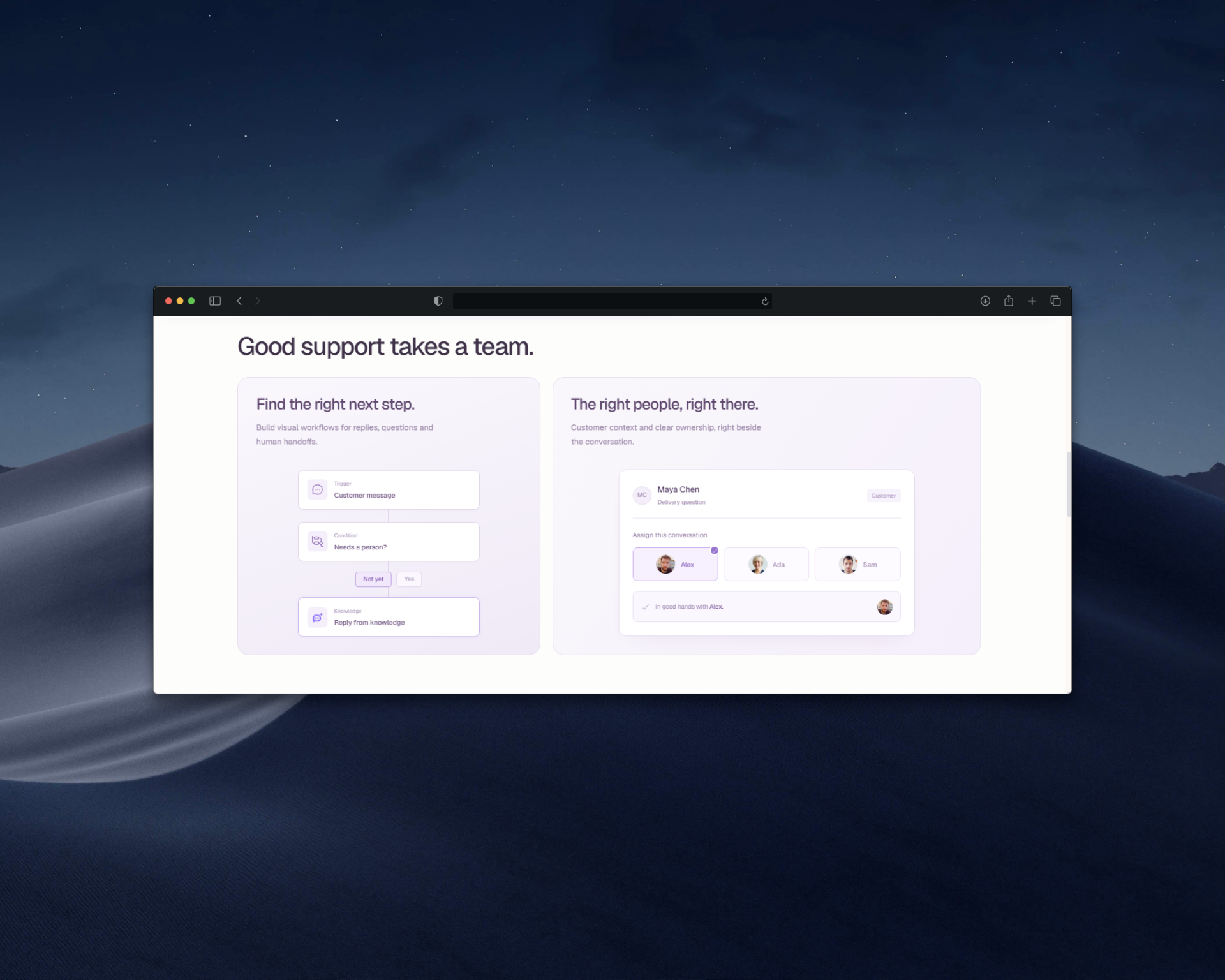
The model provides the reasoning. The surrounding system provides the environment in which that reasoning can become useful work. Why the inbox is becoming more important The support inbox is no longer just a list of conversations. It is becoming the place where human agents and AI agents share context, hand off work, and maintain continuity. When an AI can see the same conversation history, the same customer data, and the same knowledge base as the human team, it stops being a separate tool and starts functioning as part of the support environment. This is why the quality of the surrounding system matters more than the intelligence of the model alone. Access, permissions, memory, observability, and clear handoff rules determine whether an agent is helpful or chaotic. What this changes for support teams The most useful question is no longer “Where can we add AI?”A better starting point is the workflow itself. Look for the parts of support that are:
Repetitive
Information-heavy
Spread across multiple systems
Slow because humans have to move context around
Frequent enough that improvement creates real leverage
Then ask whether an agent can safely handle part of that process. Sometimes the answer is yes.
Sometimes a simpler automation is better.
Sometimes the highest value comes from a human and an agent working side by side. The goal is not to remove humans from support.
The goal is to remove the parts of the work that do not require human judgment. The larger shift What we are watching is not the arrival of smarter chatbots. It is the beginning of software that can participate in real operational work. In support, that means AI that does not just reply, but operates inside the same environment as the team — with context, constraints, and clear points of human control. The companies that treat this as infrastructure rather than a feature will build more reliable systems. The ones that treat it as a simple chatbot upgrade will keep rediscovering the same limitations.AI agents are no longer waiting outside the support workflow. They are moving in. At Pingback, this is the direction we are building toward with Theo => an AI that works inside the same inbox as your team, with shared context and clear handoffs, rather than sitting on the side as another chatbot.